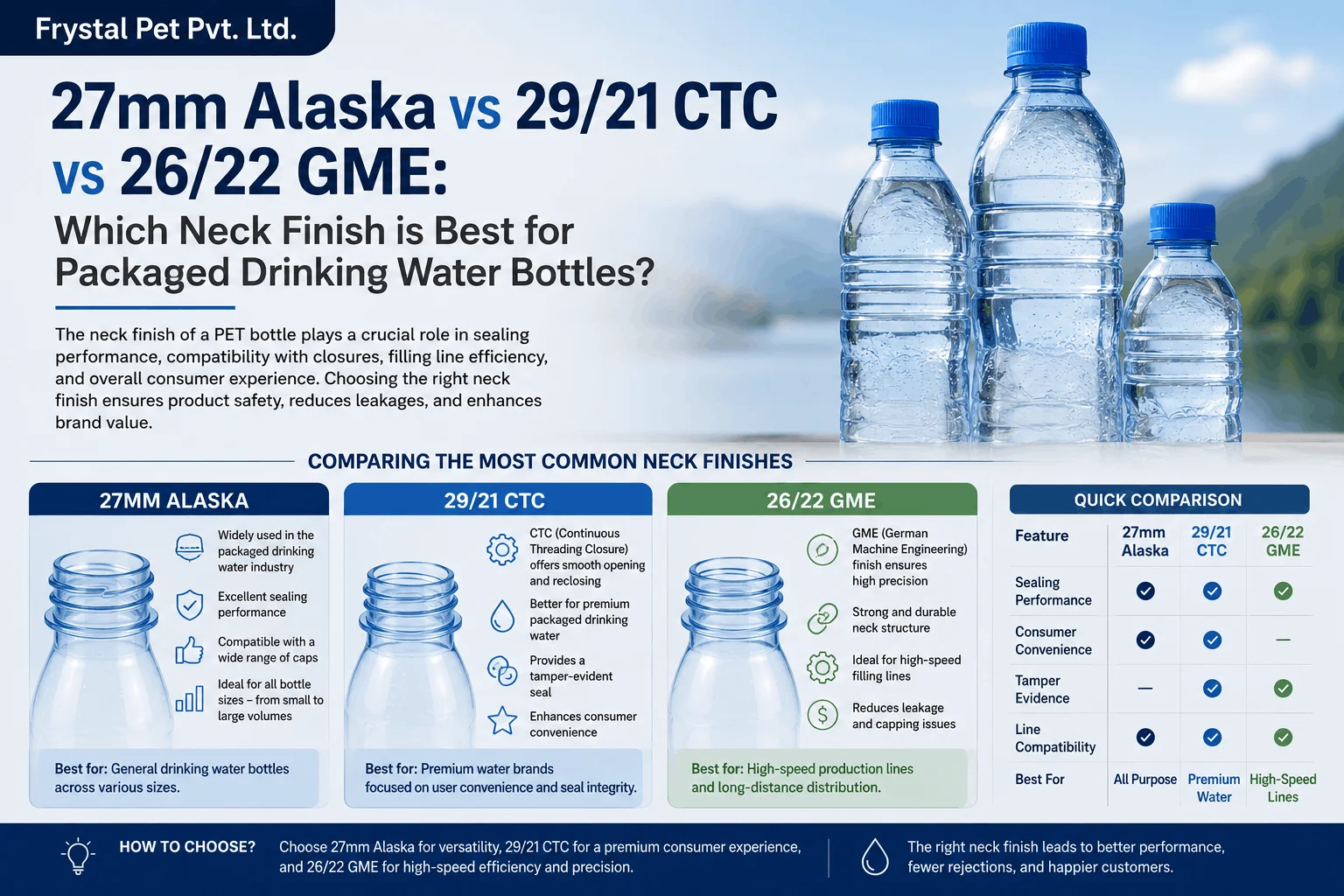
The 27mm Alaska, 29/21 CTC, and 26/22 GME are the three most common lightweight neck finishes for packaged drinking water bottles in India. All three are short neck designs built to save resin, but they differ in neck diameter, neck weight, and cap compatibility. In simple terms, GME offers maximum lightweighting, Alaska balances savings with wide cap availability, and CTC suits lines built around its specific closure standard. The right choice depends on your capping machine, closure supplier, and annual bottle volume.
This guide compares all three neck finishes point by point, explains the cost math behind lightweighting, and gives you a simple checklist to decide which preform fits your production line. Frystal Pet Pvt Ltd manufactures all three formats, so this comparison comes from real production experience, not theory.
All three families serve still water applications. None of them are meant for carbonated drinks, which require pressure resistant necks like PCO 1810 or PCO 1881.
Resin is the single largest cost in any preform. The neck section matters most because the neck does not stretch during blow molding. Every gram in the neck stays exactly where it is, so a heavier neck is pure fixed cost on every single bottle.
Consider a simple example. If switching from a standard neck to a lightweight short neck saves around 1 gram per preform, a plant producing 1 crore bottles a year saves roughly 10,000 kg of resin annually. At current PET resin prices, that saving runs into several lakh rupees every year from a single specification decision. The matching lightweight caps are also smaller, adding parallel savings on closures.
This is why packaged drinking water brands across India have moved from older 28mm and 30mm neck standards to Alaska, CTC, and GME short neck formats.
Packaged drinking water brands that want meaningful resin savings without changing to a less common closure ecosystem. Alaska caps are stocked by most Indian closure suppliers, which keeps procurement simple.
Neck weight is slightly higher than the lightest GME options, so brands chasing absolute maximum lightweighting may prefer GME if their line supports it.
Water and beverage plants whose capping equipment and closure contracts are already built around the CTC standard, and buyers who value a long proven track record on Indian filling lines.
CTC caps are not interchangeable with Alaska or GME caps. If you plan to shift neck standards later, factor in capper changeover parts and closure requalification.
High volume water brands where every fraction of a gram matters. The 26/22 GME family carries one of the lowest neck weights among mainstream water standards, making it the strongest choice for pure cost optimization at scale.
Both belong to the same 26/22 GME family with a 26mm neck and 22mm bore. The difference lies in the thread and neck height specification, which means each version pairs with its own matching closure type. Your closure supplier's cap specification decides which version you need. Always confirm the exact GME version with both your cap vendor and preform manufacturer before ordering.
Confirm your capping machine supports the GME neck ring and closure dimensions. Older cappers may need changeover parts before switching.
Yes. Switching from one neck standard to another is a routine upgrade, but it needs planning. The blow molding machine requires matching neck rings, and the capper needs compatible chucks and cap feeding parts. Closure contracts also need updating to the new cap specification.
The safest approach is transition sampling. Frystal Pet Pvt Ltd supports buyers with sample preforms in the target neck finish so the full blowing, filling, and capping cycle can be validated before committing to bulk supply. This removes guesswork and protects your production schedule.
Frystal Pet manufactures the 27mm Alaska, 29/21 CTC, 26/22 GME 30.28, and 26/22 GME 30.41 preforms under one roof at its Neemrana and Pithampur units. This means buyers can compare all three neck families with real samples from a single supplier, match weights to their bottle designs, and scale supply without juggling multiple vendors.
Every batch passes weight tolerance, clarity, and neck dimension checks, so bottles blow consistently and caps seal without leakage on high speed water lines.
There is no single best neck finish for every water plant. Alaska wins on cap availability and balance, CTC wins on established line compatibility, and GME wins on absolute lightweighting. Start with your capper and closure supply, run the volume math, and validate with samples. If you want help comparing all three necks against your bottle design and production volume, request samples from Frystal Pet Pvt Ltd and test them on your own line.
The 26/22 GME family carries one of the lowest neck weights among mainstream water bottle standards, making it the top choice for maximum resin savings at high production volumes.
Both share the same 26mm neck and 22mm bore, but they differ in thread and neck height specification, so each requires its own matching cap. Your closure supplier's specification decides which version fits your line.
No. Alaska, CTC, and GME are separate neck standards with different thread designs. Each neck finish needs its own matching closure, and mixing them causes loose caps and leakage.
No. Alaska, CTC, and GME short necks are designed for still water and non-carbonated beverages. Carbonated drinks need pressure resistant necks like PCO 1810 or PCO 1881.
No. Lightweight necks are engineered standards used by leading water brands worldwide. When manufactured with correct dimensions and quality resin, they seal and perform as reliably as heavier necks.

© 2026 Frystal Pet Pvt. Ltd. All Rights Reserved. Promoted by Webads India