A PET preform is the starting point of every plastic bottle you see in the market. Before the final shape is created, manufacturers use this small tube-like structure to form bottles through heat and air pressure. This is why the PET preform manufacturing process plays a critical role in determining the final product quality.
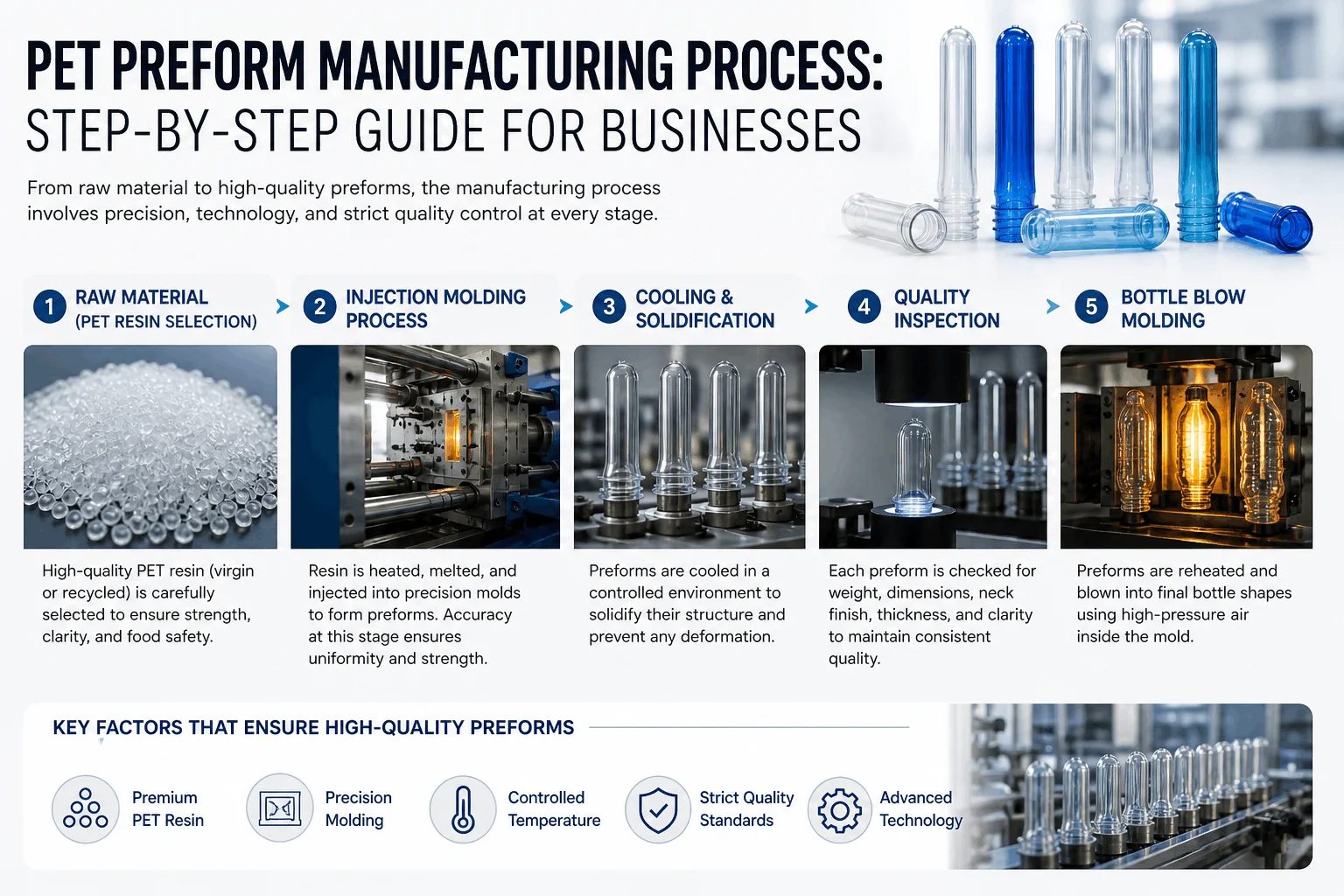
Many buyers face issues like bottle leakage, deformation, or inconsistent thickness. In most cases, the root cause is not the bottle but the preform itself. Poor preform quality leads to weak bottles, higher rejection rates, and increased production cost. Understanding how PET bottles are made helps businesses avoid these problems at the sourcing stage.
Before moving to bottle production, every batch undergoes inspection. This is where manufacturers check:
Many buyers overlook this step while selecting suppliers. Inconsistent inspection leads to production issues later. Companies like Frystal Pet Pvt Ltd focus on maintaining strict quality checks to ensure uniform preforms that perform reliably in the next stage.
Advanced machinery plays a major role in improving consistency. Modern systems like Husky and ASB machines are designed to maintain precise control over temperature, pressure, and cycle time.
This reduces variation in production and ensures uniform thickness and strength across all preforms. For businesses dealing with high-volume production, consistent output is essential to avoid downtime and wastage.
Even with the right process, certain factors can impact the final output.
Ignoring any of these factors can lead to defects that affect the usability of the bottle.
Understanding common problems helps buyers make better decisions while sourcing.
These issues often result in rejected batches, increased cost, and delays in production. Working with experienced manufacturers like Frystal Pet Pvt Ltd helps reduce such risks by maintaining consistency in the PET preform manufacturing process.
Consistency is one of the biggest challenges in plastic preform manufacturing. Businesses require suppliers who can deliver uniform batches without variation.
Frystal Pet Pvt Ltd focuses on controlled production environments, advanced machinery, and strict inspection processes. This ensures that each preform meets required specifications for weight, clarity, and strength.
Instead of dealing with frequent production issues, businesses can rely on stable supply and predictable performance.
This guide simplifies the PET preform manufacturing process for buyers who want to avoid quality issues and production losses. Understanding each stage helps in choosing the right supplier and ensuring better performance in the long run.
PET bottles are made by reheating preforms and expanding them using air pressure inside a mould. This process shapes the preform into the final bottle.
Injection moulding PET preform is the process where melted PET resin is injected into moulds to create preforms with precise shape and dimensions.
The time depends on batch size and machinery, but modern systems allow high-speed production with consistent output in the PET bottle manufacturing process.

© 2026 Frystal Pet Pvt. Ltd. All Rights Reserved. Promoted by Webads India