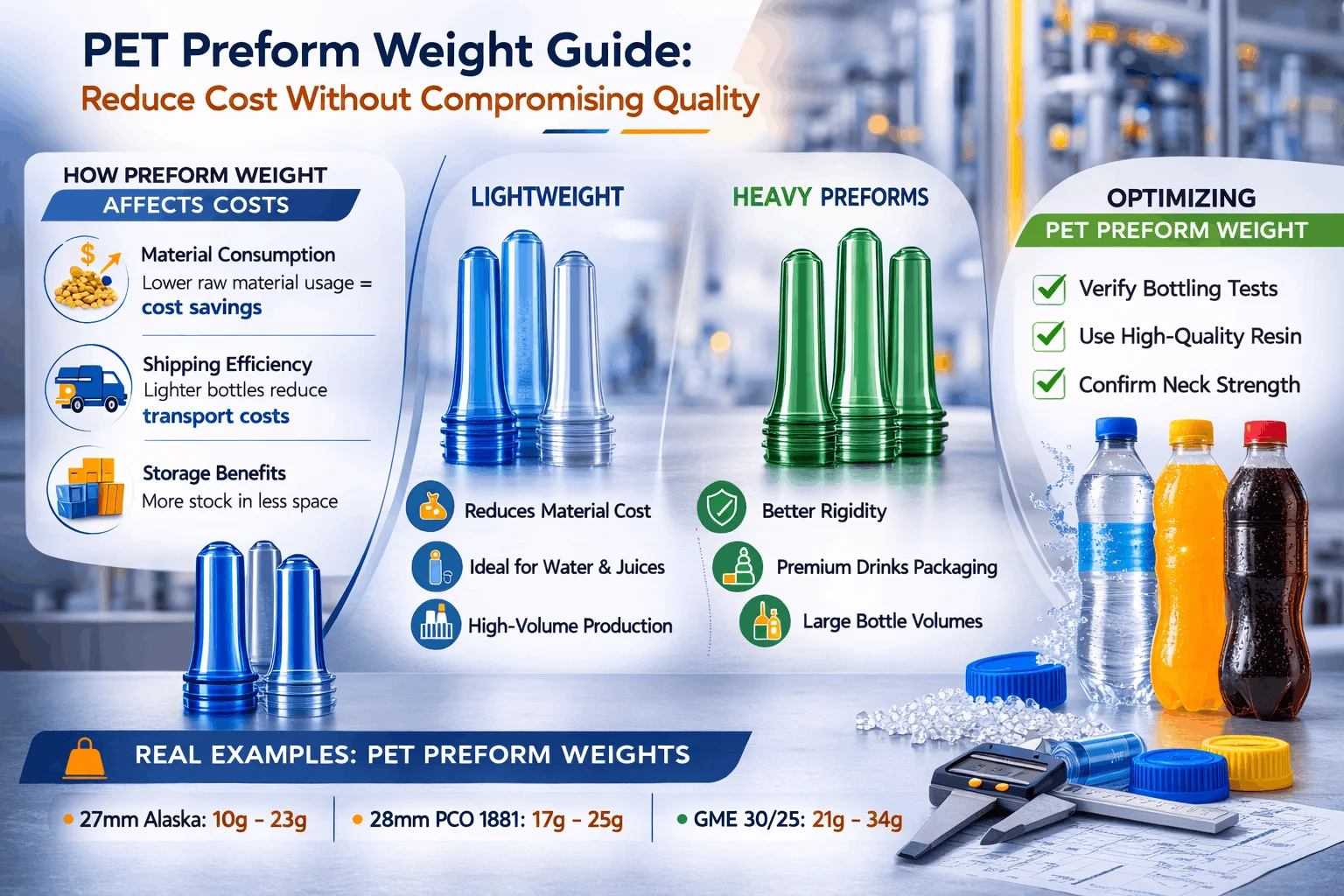
PET preform weight directly affects packaging cost, bottle strength, production efficiency, and sustainability. Choosing the correct weight helps beverage manufacturers reduce material expenses without causing bottle deformation or failure. This guide explains how PET preform weight works, when to choose lightweight or heavy preforms, and how businesses can optimize packaging for performance and cost savings.
PET preform weight refers to the number of grams used to produce a preform before blow molding.
Selecting the wrong weight can lead to weak bottles, higher expenses, or manufacturing problems.
PET preform weight determines how much material is available to form the final bottle during blow molding.
Larger bottles usually require higher weight to maintain stability, while smaller bottles can use lightweight preforms without losing strength.
The correct weight ensures bottles can handle pressure, stacking, and transportation without collapsing.
During blowing, material stretches across the mold. Proper weight distribution prevents thin walls and improves consistency.
Even small weight differences significantly impact total packaging expenses in high-volume production.
Lower weight reduces PET resin usage, which directly decreases production cost.
Lighter bottles reduce transport load, helping manufacturers save on logistics.
Reduced weight improves warehouse handling and increases operational efficiency.
For B2B buyers, weight optimization is one of the fastest ways to improve packaging profitability.
Choosing the correct category depends on product type and packaging goals.
Lightweight preforms are commonly used when reducing packaging expense is a priority.
Heavy preforms are selected when durability or premium feel is required.
Different neck finishes support multiple weight options depending on application.
Used widely for packaged water with multiple weight choices based on bottle volume.
Offers lightweight and heavier variations for carbonated and non-carbonated beverages.
Provides flexibility for balancing cost and structural performance.
Working with experienced manufacturers like Frystal Pet helps ensure the weight matches production needs.
Weight reduction should be supported by technical validation.
Compression and pressure testing confirm bottle durability after weight optimization.
High-quality PET resin allows lighter preforms without reducing performance.
Strong neck finishes ensure reliable sealing even when bottle body weight is reduced.
Weight optimization also improves environmental performance.
Reduced PET consumption lowers resource usage.
PET remains highly recyclable, supporting circular packaging systems.
Lighter packaging decreases fuel consumption during shipping.
Consulting a supplier early helps avoid costly packaging errors.
Correct weight selection prevents production issues later.
Changing bottle shape or size often requires weight adjustment.
Reviewing preform weight is a practical step when packaging costs increase.
Frystal Pet helps in choosing right weight options aligned with bottle design and production efficiency.
Yes. Lower weight reduces material usage and shipping cost while maintaining performance when properly designed.
No. Heavy preforms are only needed for specific applications requiring extra rigidity or larger bottle volumes.
Not if weight optimization is supported by proper testing and material quality.
They consider bottle size, beverage type, filling pressure, transportation needs, and production setup.
Choosing the correct PET preform weight helps balance cost, durability, and production efficiency. If you are planning a new packaging project or optimizing existing bottles, Frystal Pet can provide practical recommendations based on your bottle design and manufacturing requirements.

© 2025 Frystal Pet Pvt. Ltd. All Rights Reserved