When caps fail randomly, bottles leak after filling, or rejection rates suddenly rise on the capping line, the problem often starts much earlier than expected. In many cases, preform ovality creates capping issues that go unnoticed until production losses begin. At Frystal Pet, this is one of the most common pain points we help fillers, and brand owners resolve through tighter preform quality control and engineering-led solutions.
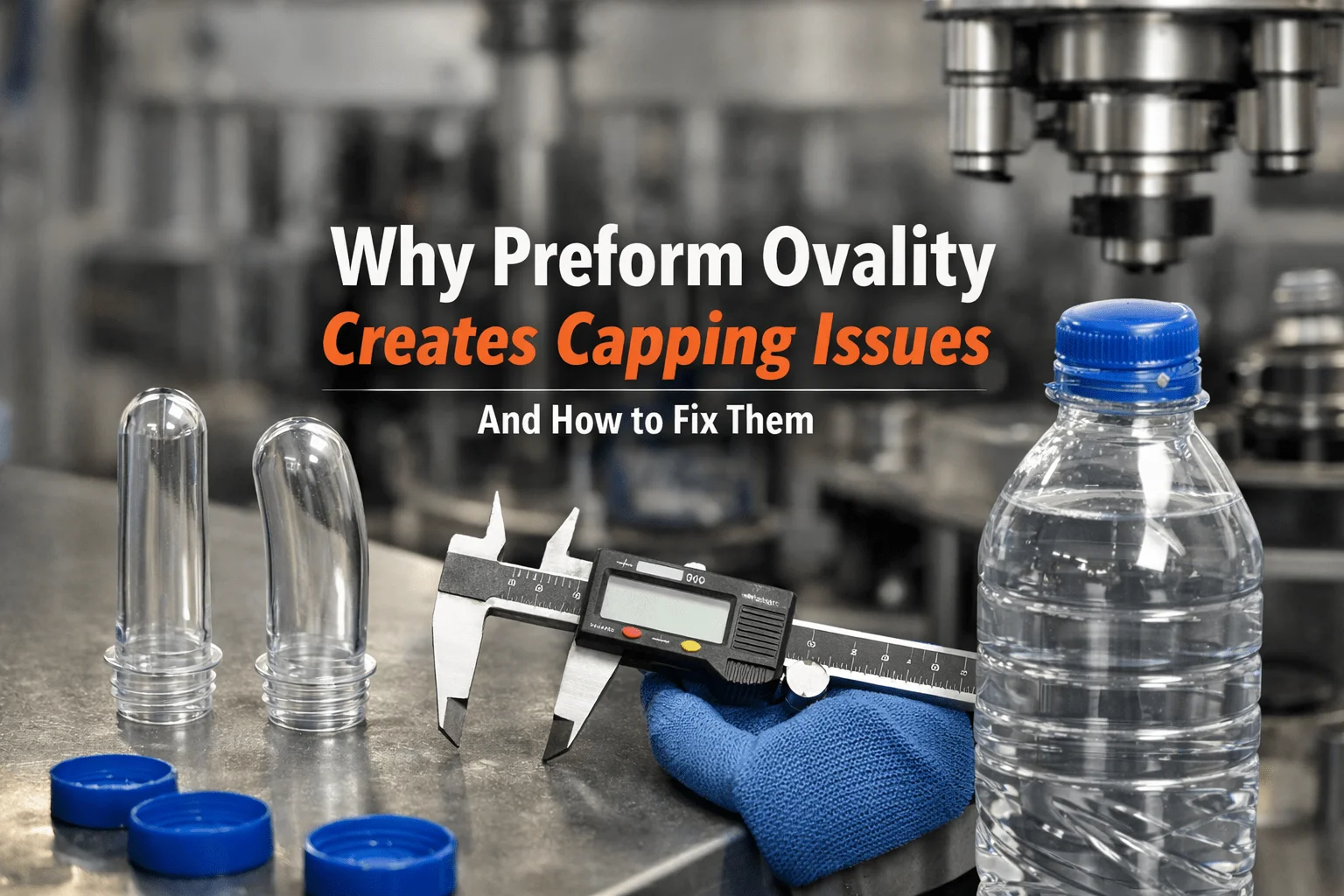
Capping problems are rarely caused by caps alone. The neck finish of a PET preform plays a direct role in sealing, torque consistency, and line efficiency. Even slight ovality in the preform neck can disrupt the entire closure system.
Preform ovality refers to a condition where the neck finish of a PET preform is not perfectly round. Instead of a uniform circular profile, the neck becomes slightly elliptical due to variations during injection molding or uneven cooling.
Although this deviation may measure only a few microns, it has a significant impact on how caps interact with the bottle during application. High-speed capping systems are especially sensitive to such dimensional inconsistencies.
Caps are designed to seal uniformly around a circular neck. When ovality exists, parts of the cap liner compress more than others. This uneven contact leads to weak sealing points, which later cause leaks during handling, transport, or storage.
Oval neck finishes result in inconsistent torque readings. Some bottles may appear over-tightened while others remain under-torqued. This creates quality risks and complicates torque validation processes for QA teams.
On automated lines, oval preforms increase the chance of cap misalignment. This can cause caps to tilt, skip threads, or cross-thread, leading to frequent stoppages and manual rework.
Leak testers and pressure tests often flag bottles that passed visual inspection but fail functional testing. This increases wastage after filling, where material and product losses are far more expensive.
Understanding the root cause is critical to solving the issue permanently.
Poor gate balance, uneven cavity cooling, or worn mold components can lead to dimensional instability in the neck area.
If cooling is not uniform around the neck ring, differential shrinkage occurs, resulting in ovality.
Improper injection pressure or inconsistent resin flow can distort the neck finish during solidification.
Many suppliers rely on basic go/no-go gauges, which do not detect micro-level ovality that affects capping performance.
Caps are easier to replace than preforms, so many operations attempt cap changes first. While cap quality matters, changing suppliers does not fix a non-round neck finish. This results in repeated trials, wasted downtime, and unresolved leakage problems.
Experienced processors know that preform ovality creates capping issues regardless of cap brand if the neck geometry is unstable.
At Frystal Pet, preform performance is engineered, not assumed. Our approach focuses on preventing ovality rather than reacting to its consequences.
Our molds are designed with optimized neck-ring geometry and balanced cooling channels to maintain circular integrity across all cavities.
We use high-accuracy dimensional inspection tools to measure roundness, not just diameter. This allows early detection of ovality trends before they affect customers.
Injection pressure, cooling time, and cycle parameters are tightly controlled to ensure consistent neck finish quality across production batches.
Preforms are validated based on the customer’s cap type, liner material, torque range, and filling speed. This ensures compatibility in real operating conditions, not just in lab tests.
If you are sourcing PET preforms, watch for these warning signs:
These symptoms often indicate a neck geometry problem rather than a capping machine fault.
Fixing preform ovality reduces:
The cost of poor neck quality multiplies downstream. Addressing it at the preform stage delivers long-term stability.
Not all preform suppliers measure success the same way. For operations where uptime, sealing integrity, and brand reputation matter, dimensional accuracy cannot be compromised.
At Frystal Pet, preform consistency is treated as a functional requirement, not a tolerance allowance. Our engineering and quality teams work together to ensure that preforms perform reliably on real production lines.
Capping failures are often the visible symptom of an invisible problem. When preform ovality creates capping issues, the solution lies in better preform engineering, measurement, and process control, not quick fixes at the capping station.
For manufacturers looking to reduce leakage, stabilize torque, and improve line efficiency, starting with the right PET preform makes all the difference. Frystal Pet focuses on solving these challenges at the source so your production runs smoothly, batch after batch.

© 2026 Frystal Pet Pvt. Ltd. All Rights Reserved. Promoted by Webads India