
Intrinsic viscosity, written as IV and measured in deciliters per gram (dl/g), is a measure of the length of the PET polymer chains in the resin. In plain terms, it tells you how long the molecular chains are, and longer chains mean a stronger material. IV directly decides how strong, clear, and pressure resistant the finished bottle will be. A higher IV gives more strength and better resistance to pressure, while a lower IV is easier to process but weaker. The right IV is not the highest number, it is the one matched to your application, whether that is still water, carbonated drinks, or hot fill.
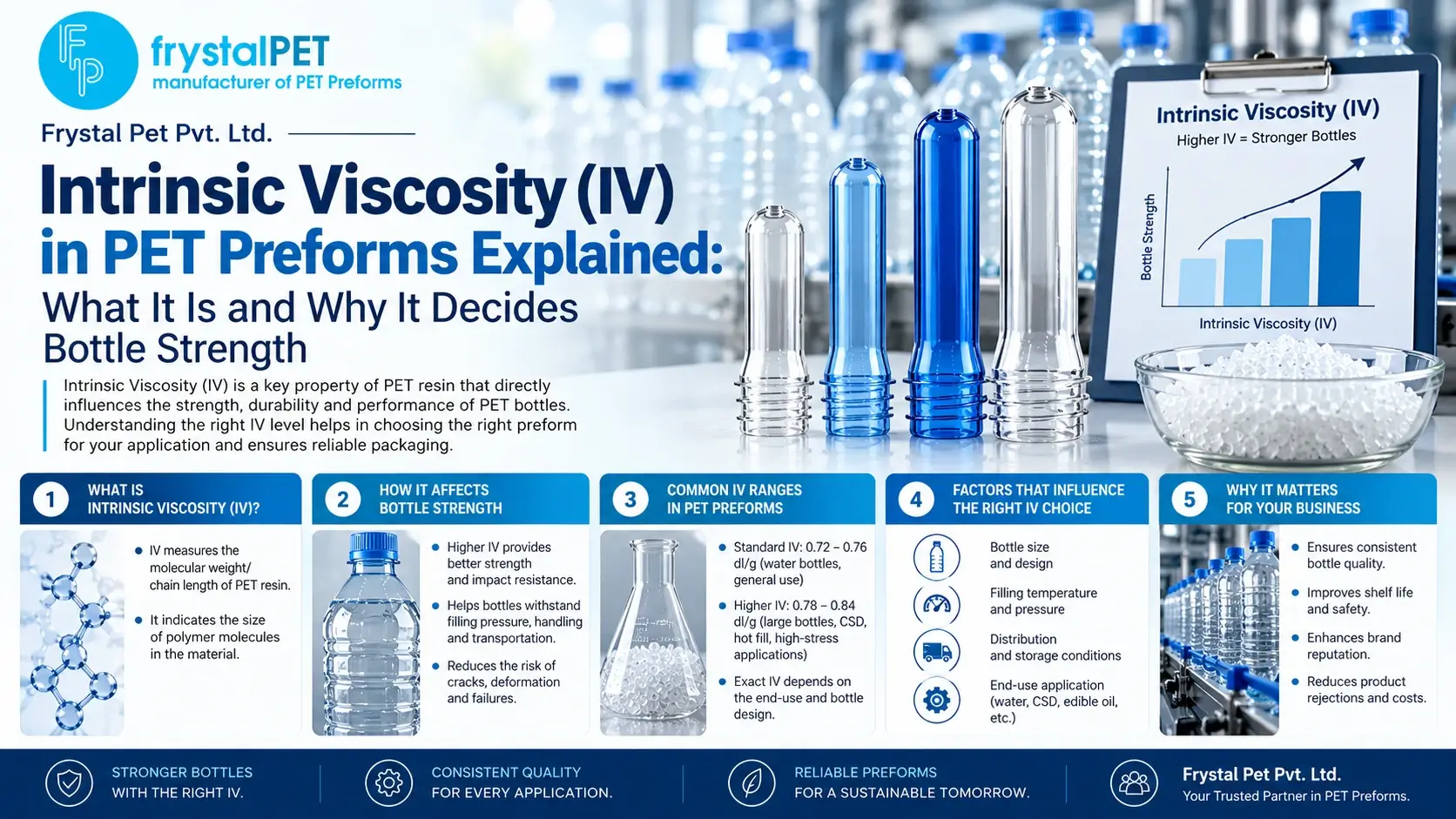
IV is one of the most important specifications in any preform, yet it is often overlooked by buyers who focus only on weight and neck size. Understanding it helps you avoid weak bottles, stress cracking, and flat carbonated drinks. This guide explains what IV is, why it matters, and how it changes by application.
Think of PET resin as a bundle of molecular chains. Intrinsic viscosity measures the average length of those chains. Longer chains tangle together more and create a stronger, tougher material, which is why a higher IV resin produces a more robust bottle.
IV is expressed in deciliters per gram, or dl/g. You will see preform and resin specifications quoted as an IV value in this unit. Water grade resins sit at the lower end of the common range, and carbonated grade resins sit higher, because carbonation demands more strength. The exact value depends on the resin grade and application, so it should always be matched to what you are packing rather than chosen at random.
IV affects how well a bottle holds its shape under load, such as when cases are stacked in a warehouse. Too low an IV and bottles deform or buckle. The right IV gives the finished bottle the structural strength it needs for its contents and handling.
Carbonated soft drinks put constant outward pressure on the bottle, which is why they need a higher IV resin than still water. The added chain length gives the wall and base the strength to resist bulging and stress cracking. Our guide on PET preforms for carbonated soft drinks explains how this works alongside neck and base design.
IV also influences the blowing window and the clarity of the finished bottle. A resin that is too high in IV can be harder to process and may affect clarity if not handled correctly, while the right IV blows cleanly into a clear, uniform bottle.
Different products need different IV levels. Here is how the common applications compare on a relative basis.
This is why a single IV does not fit every product. Matching the resin grade to the application is a core part of specifying the right preform.
Getting IV wrong in either direction causes real problems on the line and in the market.
Consistency matters as much as the target number. Bottles can only perform reliably when the IV is both correct and stable across every batch.
Recycled PET can vary in intrinsic viscosity because it comes from mixed sources that have already been through one heat history. When rPET is blended with virgin resin to meet recycled content rules, maintaining a consistent IV in the final blend becomes a key quality control point. A well controlled blend holds its target IV, while a poorly controlled one drifts and causes variable bottle performance. Our rPET and recycled content mandate guide covers how blends are managed for compliance.
Good preform manufacturing protects IV at every step. It starts with selecting the correct resin grade for the application, then drying the resin properly, because moisture during processing breaks the polymer chains and drops the IV. Careful temperature and process control during injection molding prevents further loss, and consistent practices keep the IV stable from batch to batch.
Frystal Pet Pvt Ltd selects resin grades matched to each buyer's application and controls processing at its Neemrana and Pithampur units so the finished preforms carry the right IV consistently. This is what turns a correct specification on paper into bottles that actually perform.
Intrinsic viscosity is the hidden specification that decides whether your bottles are strong, clear, and fit for their contents. It is not about chasing the highest number, but about matching the resin grade to your application and keeping it consistent across every batch. When you specify a preform, ask about IV alongside weight and neck finish. To discuss the right IV specification for your product, connect with Frystal Pet Pvt Ltd.
Still water preforms use a lower IV resin than carbonated grades, because there is no internal pressure to resist. The exact value depends on the resin grade and bottle design, so it should be confirmed with your supplier against your specific application.
Carbonation puts constant outward pressure on the bottle. A higher IV resin has longer polymer chains that give the wall and base the strength to resist bulging and stress cracking and to retain CO2 over shelf life.
Recycled PET can vary in IV because it has already been through a heat history and comes from mixed sources. This is why blend consistency and quality control are important when using rPET to meet recycled content requirements.
IV influences the blowing window and how evenly the material stretches. The correct IV blows into a clear, uniform bottle, while an incorrect IV or poor processing can lead to haze or uneven walls.
Yes. An IV that is too low produces weak bottles prone to stress cracking and poor top load strength, while an inconsistent IV causes unpredictable performance from batch to batch. Matching and controlling IV prevents these failures.

© 2026 Frystal Pet Pvt. Ltd. All Rights Reserved. Promoted by Webads India