
Carbonated soft drinks put constant internal pressure on the bottle because of dissolved carbon dioxide, so a CSD preform is built differently from a still water preform in three key ways. It uses a pressure rated neck finish, usually PCO 1810 or PCO 1881, it blows into a petaloid base that resists bulging, and it has wall and weight design tuned to hold carbonation over shelf life. Getting any of these wrong leads to base deformation, leaking caps, stress cracking, or flat product. This guide explains what makes a CSD preform work and how to choose the right one.
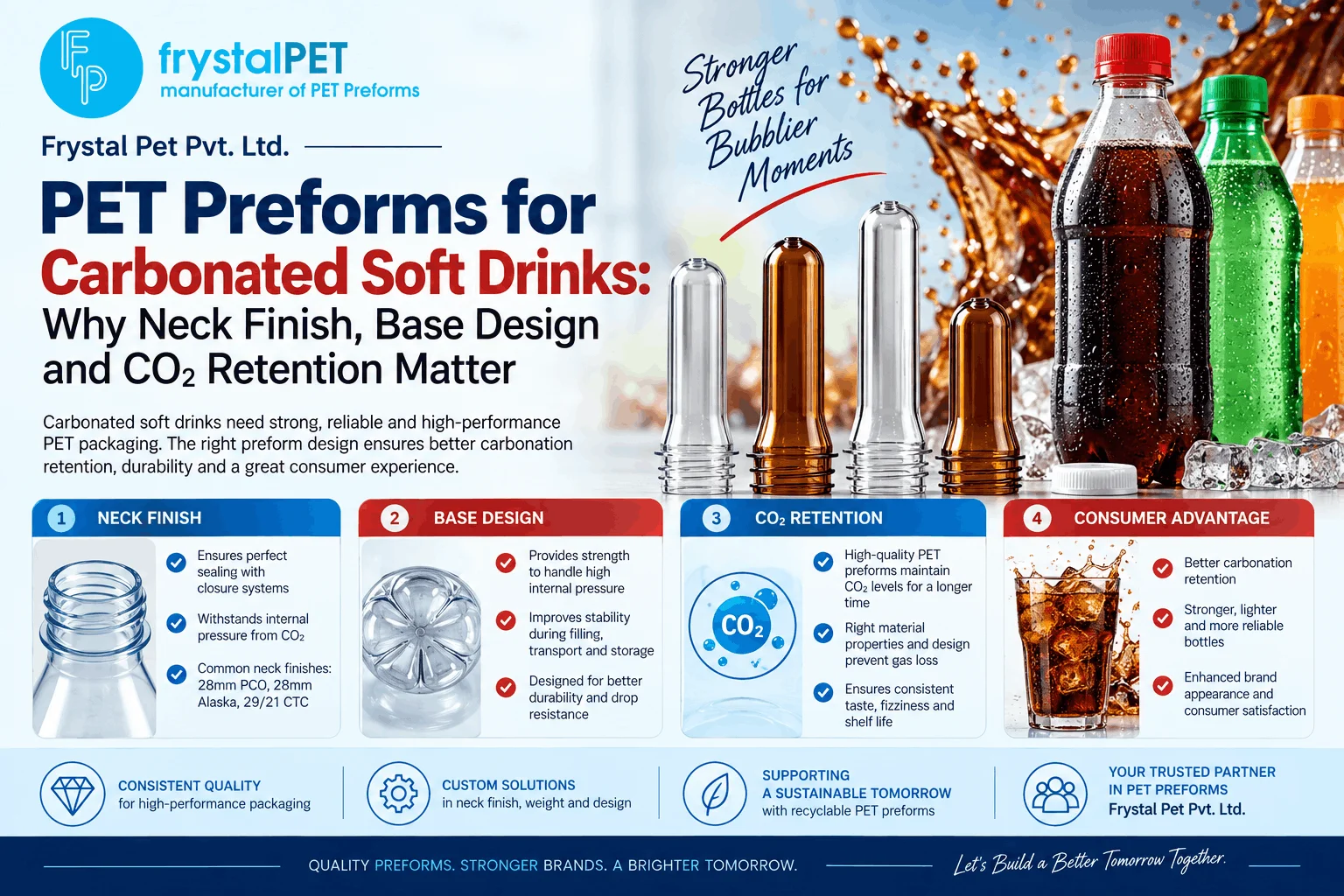
If you bottle sodas, flavored fizzy drinks, soda water, or any carbonated beverage, the preform decision directly affects product safety, shelf life, and rejection rates on your line. Here is what carbonation demands from a preform and what to check before you buy.
Still water sits inside the bottle at normal pressure. A carbonated drink is the opposite. The dissolved carbon dioxide constantly pushes outward on every surface of the bottle, and that pressure rises further in heat during storage and transport. A preform designed only for water simply cannot handle this load.
When the wrong preform is used for carbonation, common failures include:
This is why CSD packaging starts with a preform engineered for pressure, not a general purpose one.
A petaloid base is the five footed, flower shaped bottom used on carbonated bottles. Instead of a flat or simple push up base, it has curved feet that spread the internal pressure evenly and let the bottle stand upright under load. This shape is the single biggest structural difference between a soda bottle and a water bottle.
A flat base has no way to absorb outward pressure at the bottom, so it bulges and the bottle becomes unstable. The petaloid design channels stress into the feet, which resist deformation and keep the bottle standing.
The base is formed during blow molding, but the preform decides how much material reaches the base and how evenly it distributes. A poorly designed or underweight preform starves the base of material, creating thin spots that crack under pressure. This is why CSD preform weight and design are matched to the bottle base, not chosen at random.
Carbonated bottles use pressure rated neck finishes, and the two industry standards are PCO 1810 and PCO 1881. Both are designed to lock the cap pressure tight so carbonation does not escape at the seal. PCO 1881 is the lighter, shorter successor to PCO 1810 and is widely used for lightweighting, while PCO 1810 remains in use on many established lines.
Choosing between them depends on your capping equipment and closure supply. Rather than repeat the full breakdown here, see our dedicated PCO 1810 vs PCO 1881 comparison for the complete spec by spec guide. The important point for CSD is that both are pressure rated necks, unlike the short water necks such as Alaska, CTC, and GME covered in our water bottle neck comparison, which are not built for carbonation.
A carbonated drink is only good while it holds its fizz. CO2 slowly permeates out through the bottle wall over time, and preform quality directly affects how fast this happens.
For longer shelf life on higher value products, some brands also add barrier measures, but the foundation is always a correctly specified, consistent preform.
Every one of these traces back to preform quality and correct specification, which is why supplier selection matters so much for carbonated products.
Confirm the preform is intended for carbonated use and feeds a petaloid base with adequate material distribution.
Ask whether the resin intrinsic viscosity suits carbonated applications, since this drives strength and CO2 retention.
Pressure tight sealing depends on accurate neck dimensions batch after batch. Ask how neck quality is controlled.
Always run sample preforms through your own blowing, filling, and capping cycle before bulk supply to validate real performance under pressure.
Frystal Pet Pvt Ltd manufactures both PCO 1810 and PCO 1881 neck preforms, the two standards used for carbonated soft drinks, at its Neemrana and Pithampur units. The team helps CSD bottlers match preform weight and neck finish to their bottle design and capping line, and supports sampling so performance is validated under real pressure before scaling up.
With consistent neck dimensions and correctly specified material, the result is stable bottles that hold their carbonation and run cleanly on high speed filling lines.
Carbonated soft drinks demand more from a preform than still water ever will. The three essentials are a pressure rated PCO neck finish, a petaloid base fed by correct material distribution, and consistent quality that retains CO2 across shelf life. Choose the neck to match your capping line, validate with samples, and work with a supplier who understands carbonation. To discuss PCO preforms for your soda or CSD line, request samples from Frystal Pet Pvt Ltd.
No. Water preforms and their short necks and flat bases are not built for the internal pressure of carbonation. Carbonated drinks need a pressure rated PCO neck and a petaloid base to avoid deformation and leaking.
Both are valid carbonated standards. PCO 1881 is lighter and often chosen for lightweighting, while PCO 1810 remains common on established lines. The right choice depends on your capping equipment and closure supply.
A petaloid base is the five footed, flower shaped bottom used on carbonated bottles. It spreads internal pressure into curved feet so the bottle stays upright and does not bulge under carbonation.
CO2 slowly permeates out through the bottle wall. Even wall distribution, the right resin, and consistent preform quality slow this loss and keep the drink fizzy for longer.
Carbonated applications use a higher intrinsic viscosity PET resin than still water, because it provides the added strength and barrier needed to withstand pressure and retain carbonation.

© 2026 Frystal Pet Pvt. Ltd. All Rights Reserved. Promoted by Webads India